Oil is not soluble in water
It is well known that fats and oils are insoluble in water. When oil is mixed with water, the two liquids create two distinctive layers in a matter of seconds. The inability of oil to mix with water is called the hydrophobic effect. When oil is deposited on surfaces, detergents may be used for its removal. Detergents have been around for more than 100 years, and their use are part of the household routine for people worldwide. Apart from its benefits of easily removing fats and oil, detergents come with some disadvantages such as water and environmental pollution. In response to the ecological challenges posed by conventional detergents, researchers are now exploring approaches that imply minimal detergent usage. Many of these methods rely on understanding and using the water properties in smart ways.
Cleaning mechanisms
Do we need to dissolve the oil in order to clean a surface? The answer is no. Although dissolution can be important at certain conditions, oil can be removed from a surface in the form of droplets, without dissolving it into individual molecules. An example is so-called roll-up mechanism, shown in Figure 1

Figure 1. The roll-up mechanism of removal of oil from a solid surface
Does the water purity make a difference?
Purifying water from impurities would normally not increase the solubility of oil. So, does the water purity really make a difference? An area of science called Surface and Colloid Chemistry can give an answer to this question. In this field of science, it is known that most surfaces, particles and droplets are negatively charged in liquid water, see Figure 2. Negatively charged particles repel each other, and this effect is enhanced when salt ions are removed from water.
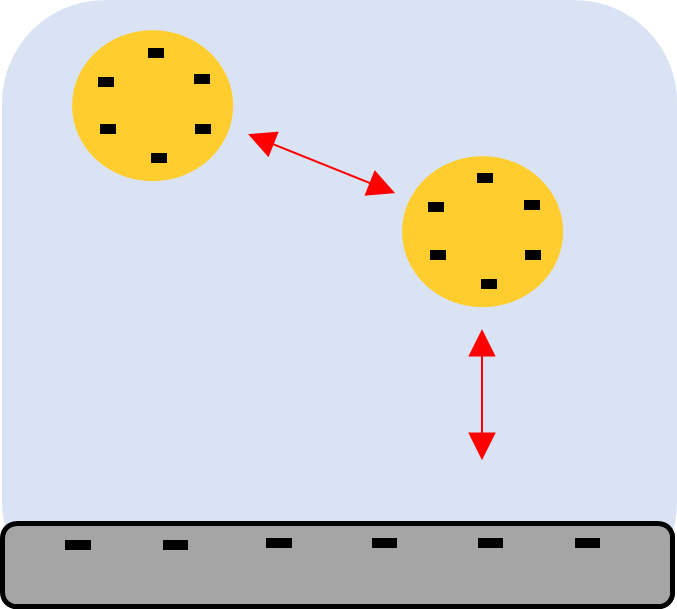
Figure 2. Electrostatic repulsion between negatively charged oil droplets and a solid surface in water.
Our experiments
In our work we study two different systems. In one system, the removal of thin vaseline layers is monitored while in the second system, thicker films of liquid oil are removed. In both cases, the soil is deposited on a hydrophilic surface. Different temperatures and numbers of washing cycles were also tested.
We worked with several water grades which can be divided in two groups: purified and non-purified. Purified water grades are free of salts, bacteria, metallic, organic contaminants, while non-purified grades include normal tap water and salt solutions.
Removal of thin nanofilms
Our results show that purified water removes more than 90% of a vaseline film deposited of the surface while tap water only 75%. A surfactant solution fully removes the deposited layer (but only after rinsing with water). The removal of the vaseline film with purified water primarily takes place at the beginning of the washing process when water is initially introduced into the system. Water can penetrate between the vaseline and the surface (Figure3) causing detachment of the thin film. Using purified water assists the process because absence of salts facilitates the repulsion between the film and the surface.
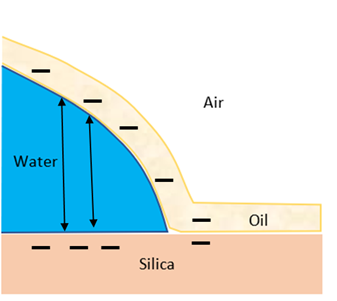
Figure 3: Removal of a thin vaseline film from a silica surface
Removal of liquid oil from the glass surface
When the removal of thick oil films was studied, we found that purified water grades showed better efficiency than TAP water. The performance of NaCl solution after one cycle was worse than for purified water, but very similar after several cycles.
When studying repeating washing cycles, we observed two distinct regimes. The initial regime, which we call the “exponential regime,” we saw a fast removal of oil while in the second regime, the oil is removed slower. By separating the process into two regimes, we were able to identify the washing mechanisms responsible for the oil removal in each regime.
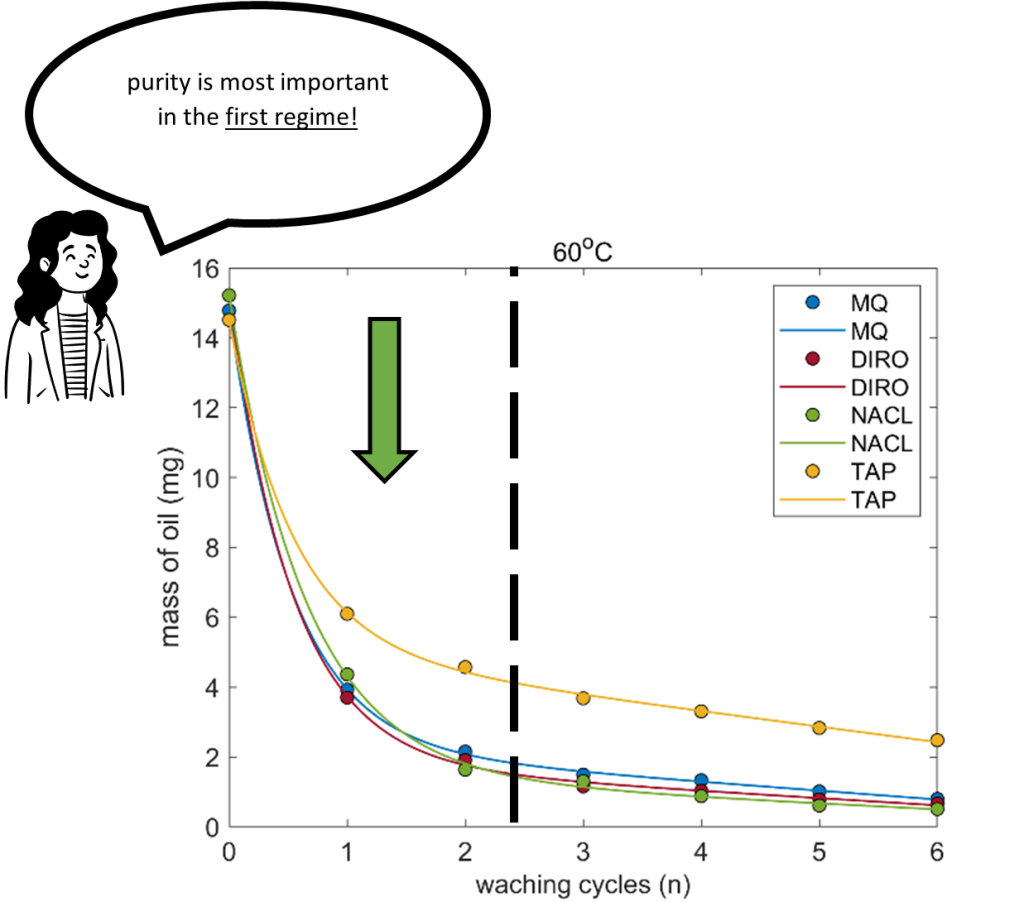
Figure 4. The mass of oil quickly decreases in the first two washing cycles and then slowly in the following cycles. The purity of water is most important in the first regime.
The fast removal of oil in the first regime happens because of the roll up mechanism. According to roll up, the oil of the surface can form big droplets that can be easily removed when water starts washing the surface. Once the oil droplets are removed, they stay dispersed in the water. The purity of water is important here because it prevents aggregation and redeposition of droplets. Introducing salts will hinder this effect by diminishing the repulsive forces of the oil droplets.
In the second regime, the roll up mechanism can not be of use as the amount of the oil on the surface is not sufficient for the formation of droplets. Because of that, another mechanism – solubility is responsible for the oil removal. Since solubility of oil in water is low, washing on the surface in this regime happens slowly.
Conclusion
Purified water facilitates washing of hydrophilic surfaces by promoting repulsion between the surfaces and the oil. However, since water purification does not make the oil soluble, multiple washing cycles and temperature control are needed to achieve good washing efficiency.
Andriani Tsompou, PhD student, Malmö university
Vitaly Kocherbitov, Professor, Malmö university